




Table of Contents
ToggleEndüstriyel IQF Paketleme Makinası
Packaging individually quick frozen (IQF) products requires far more than high production speed. Since these products are processed at low temperatures and have unique flow characteristics, they demand packaging systems capable of maintaining accuracy, product integrity, and operational stability throughout the production process.
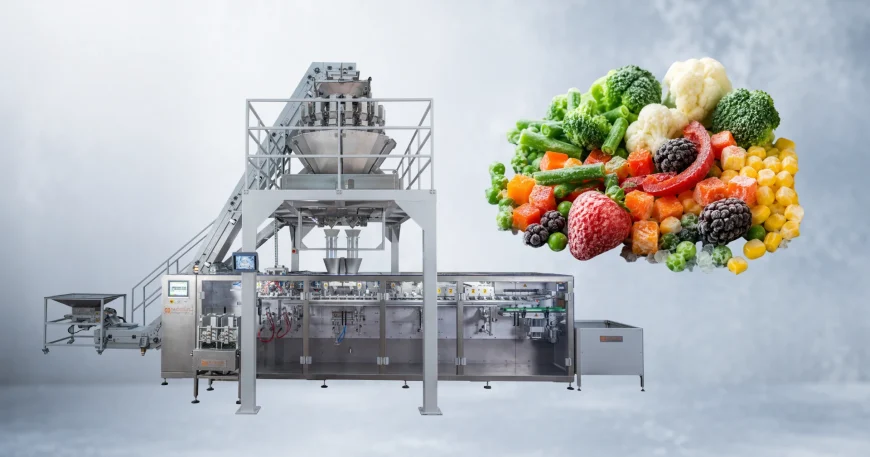
An IQF packaging machine is specifically designed to handle frozen food products without compromising weighing accuracy, product quality, or packaging performance. In this guide, we explain how IQF packaging systems work, which products they are suitable for, how the right filling system is selected, and the key engineering considerations that improve packaging efficiency.
What Is an IQF Packaging Machine and How Does It Work?
An IQF packaging machine is designed to package individually quick frozen products efficiently while maintaining accurate weight control and protecting product quality.
Unlike conventional packaging equipment, IQF systems must operate reliably in low-temperature environments while handling products with varying shapes, sizes, and flow characteristics.
A typical packaging line consists of three main stages:
- Product feeding
- Precise weighing or dosing
- Bag forming, filling, and sealing
Frozen products are transferred through an optimized feeding system to a multihead weigher or another suitable dosing solution. Once the target weight is achieved, the product is discharged into the selected packaging format, such as pillow bags, gusset bags, or stand-up pouches.
The most important factor is not simply achieving maximum speed but maintaining consistent packaging performance throughout continuous production.
Why Do IQF Products Require Specialized Packaging Solutions?
IQF products behave differently from powders, granules, or dry foods.
Because they are processed at freezing temperatures, they present unique challenges during packaging, including:
- Moisture formation on product surfaces
- Product bridging and sticking
- Irregular product flow
- Fragile structures that can easily be damaged
For this reason, an IQF packaging machine is engineered not only to package products but also to manage their behavior during the filling process.
A properly designed system minimizes waste while maximizing productivity.
Which Products Can Be Packaged with an IQF Packaging Machine?
IQF technology is widely used across the frozen food industry.
Common applications include:
- Frozen vegetables
- Frozen berries and fruits
- French fries and potato products
- Shrimp and seafood
- Frozen meat and poultry
- Ready meal ingredients
- Mixed vegetable blends
Each product category has unique flow characteristics, making machine configuration an important part of the overall packaging solution.
How to Select the Right Filling System for IQF Products
Selecting the appropriate filling system has a direct impact on production efficiency and weighing accuracy.
Several factors should be evaluated before choosing the system:
- Product size and shape
- Surface texture
- Target package weight
- Required production capacity
- Product fragility
Multihead weighers are the preferred solution for most IQF applications because they offer high-speed operation with excellent weighing precision.
However, sticky or irregular frozen products may require specially coated contact surfaces or customized feeding systems to maintain consistent flow.
How Can Product Sticking and Flow Issues Be Prevented?
One of the most common challenges in frozen food packaging is inconsistent product flow.
When products stick together or fail to flow smoothly, production efficiency decreases while weight variation increases.
Several engineering solutions help eliminate these problems:
- Vibratory feeding systems
- Anti-stick contact surfaces
- Optimized hopper geometry
- Controlled product distribution
- Stable environmental conditions
Instead of forcing product movement, a properly engineered IQF packaging system ensures a smooth and natural flow throughout the packaging process.
How Is Accurate Weight Control Achieved?
Accurate weight control is one of the most important performance indicators in frozen food packaging.
Overfilling increases product giveaway, while underfilling can lead to customer complaints and compliance issues.
Weight accuracy depends on several factors:
| Factor | Impact | Solution |
|---|---|---|
| Inconsistent product flow | Weight variation | Optimized feeding system |
| Product sticking | Irregular filling | Anti-stick surfaces |
| Low operating temperature | Sensor instability | Proper component selection |
| High production speed | Reduced weighing accuracy | Servo motion optimization |
Combining high-precision weighing equipment with stable product flow allows manufacturers to achieve excellent packaging consistency.
What Determines IQF Packaging Machine Prices?
The cost of an IQF packaging machine depends on the production requirements rather than a single standard specification.
Several factors influence the investment:
- Packaging speed
- Filling technology
- Packaging format
- Automation level
- Optional equipment
- Integration with inspection systems
Additional systems such as nitrogen flushing, checkweighers, metal detectors, labeling units, and automatic case packing solutions can significantly affect the final project cost.
Instead of focusing solely on purchase price, manufacturers should evaluate the total cost of ownership throughout the machine’s operating life.
Why Are Servo and Motion Control Systems Critical?
Modern packaging machines rely heavily on servo-driven motion technology.
Servo systems provide:
- Precise synchronization
- Stable production speed
- Fast recipe changeovers
- Higher packaging accuracy
- Reduced mechanical wear
- Improved production efficiency
For IQF applications, where product flow continuously changes, servo technology enables the packaging machine to react instantly and maintain stable operation.
Hygiene and Food Safety Standards in Frozen Food Packaging
Food safety is one of the highest priorities in frozen food production.
An industrial IQF packaging machine should be designed according to hygienic engineering principles.
Important design features include:
- Stainless steel construction
- Easy-to-clean surfaces
- Food-grade contact materials
- Hygienic frame design
- Minimal contamination risk
- Easy maintenance access
A hygienically designed packaging system not only supports food safety but also reduces cleaning time and increases overall production efficiency.
Conclusion
Selecting the right IQF packaging machine is a strategic investment for frozen food manufacturers.
A properly engineered system delivers stable production, accurate weighing, gentle product handling, and long-term operational reliability. Rather than focusing only on machine speed, manufacturers should prioritize consistent performance, hygienic design, flexible automation, and packaging accuracy.
At Packplus, we develop advanced IQF packaging solutions tailored to the specific requirements of frozen food production, helping manufacturers improve efficiency while maintaining the highest product quality.