




Table of Contents
ToggleHigh-Speed Packaging Machine Solutions
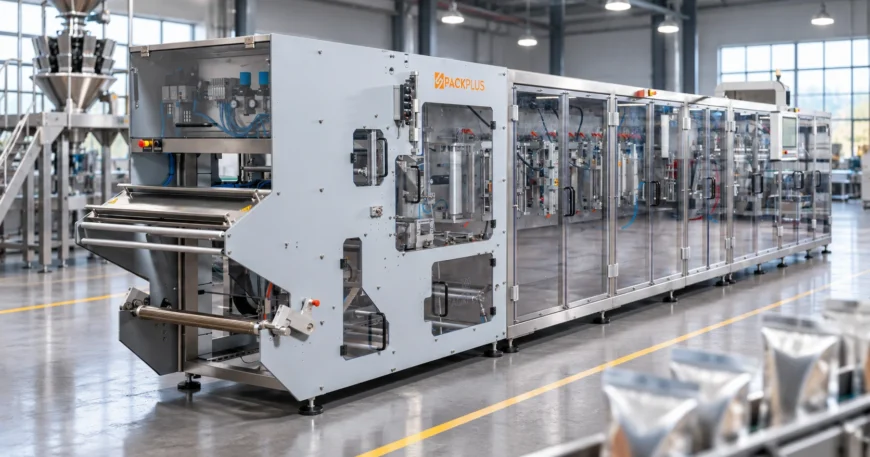
Increasing production capacity requirements in industrial manufacturing are driving businesses toward faster, more precise, and more efficient packaging technologies. A high-speed packaging machine is an automated production system designed to package products at specified weights, in suitable packaging formats, with minimal operator intervention.
Widely used in the food, chemical, cosmetics, and other manufacturing industries, these systems help manufacturers increase production capacity, control labor costs, reduce product waste, and maintain consistent packaging quality.
As a packaging machinery manufacturer based in Türkiye, Packplus develops high-capacity packaging, filling, and automation solutions tailored to different product characteristics and production requirements.
What Is a High-Speed Packaging Machine and Why Is It Preferred?
A high-speed packaging machine is industrial equipment that automatically performs product feeding, weighing, filling, bag forming, and sealing operations. Unlike conventional systems, it features mechanical and electronic components engineered to operate at higher cycle speeds.
Manufacturers prefer these technologies for several important reasons:
- Higher production capacity: More products can be packaged within the same operating period.
- Consistent packaging quality: Greater uniformity in filling weights and package dimensions.
- Reduced operator dependency: Repetitive packaging operations are automated.
- Production flexibility: Depending on the machine configuration, different products and packaging formats can be processed.
Evaluation Criteria | Manual Packaging | Automatic Packaging |
|---|---|---|
Production capacity | Operator-dependent | Higher and more consistent |
Weight control | Manual measurement | Integrated weighing system |
Labor requirements | Higher | Lower |
Traceability | Limited | Digital monitoring available |
Initial investment | Lower | Higher |
The benefits of automation extend beyond packaging speed. Particularly during extended production shifts, operational continuity and repeatable packaging quality provide significant advantages.
How Many Packages per Minute Can a High-Speed Packaging Machine Produce?
The production capacity of a high-speed packaging machine depends on product flow characteristics, target filling weight, package dimensions, filling technology, and machine configuration.
For example, certain Packplus packaging systems offer the following approximate nominal production capacities:
Machine Configuration | Approximate Capacity |
|---|---|
Roll Film Doypack Single | 45–60 packages/min |
Roll Film Doypack Twin | 80–90 packages/min |
Premade Pouch Duplex | 30–50 packages/min |
Suitable Vertical Packaging Applications | 60–120 packages/min |
These figures represent indicative production ranges rather than guaranteed speeds for every product. Actual performance must be verified through product testing and evaluation under operating conditions.
For example, a packaging machine operating at 90 packages per minute can theoretically produce 43,200 packages during an eight-hour shift. However, machine downtime, cleaning procedures, product changeovers, and operational losses affect actual production output.
Therefore, manufacturers should evaluate not only nominal packaging speed but also Overall Equipment Effectiveness (OEE) and the number of acceptable packages produced per shift.
Which Products Can Be Packaged with a High-Speed Packaging Machine?
High-speed packaging systems can process granular, powdered, liquid, particulate, and irregularly shaped products. Selecting the appropriate filling technology directly influences packaging speed and weight accuracy.
Product Category | Example Products | Suitable Filling System |
|---|---|---|
Solid food products | Nuts, chips, confectionery | Multihead weigher |
Granular products | Pulses, rice, sugar | Multihead or linear weigher |
Powder products | Flour, spices, detergent | Auger filling system |
Liquid products | Sauces, oils, shampoo | Liquid filling unit |
Irregularly shaped products | Pasta, frozen foods | Product-specific weighing system |
When selecting a food packaging system, manufacturers should carefully evaluate product fragility, moisture content, stickiness, and flow characteristics.
Packplus provides integrated packaging solutions incorporating Granule Filling Machines, Powder Filling Machines, and Liquid Filling Machines for applications across different industries.
How Can Production Efficiency Be Increased?
Improving production efficiency requires more than increasing machine cycle speed. The key is ensuring that the entire packaging line operates consistently, with balanced equipment capacities and minimal interruptions.
The following steps are essential for optimizing high-speed packaging operations:
Bottleneck analysis: Identify capacity limitations in weighing, filling, and package discharge operations.
Product feeding optimization: Maintain a stable and continuous product supply to the packaging machine.
Reduced changeover times: Simplify transitions between different filling weights and packaging formats.
Preventive maintenance: Inspect and replace wear components before they cause unexpected downtime.
Performance monitoring: Record machine stoppages, production losses, and rejected packages.
Energy consumption should also be considered when evaluating production efficiency. Measuring energy consumption per package allows manufacturers to compare different machine configurations more accurately.
High-Speed Packaging Solutions for Doypack and Stick Packs
Doypack and stick packaging formats serve different product presentation and production requirements. Doypack packaging offers a flexible, stand-up pouch structure, while stick packs are generally preferred for narrow, elongated, single-serving portions.
Feature | Doypack Packaging | Stick Pack Packaging |
|---|---|---|
Packaging structure | Stand-up pouch | Narrow, elongated package |
Typical applications | Coffee, nuts, liquids | Sugar, coffee, powdered products |
Filling technology | Weighing, auger, liquid filling | Product-specific dosing |
High-speed configuration | Single/Twin systems | Multi-lane systems |
Main advantage | Shelf presentation and flexibility | Portion control and compact packaging |
There are significant differences between Premade Pouch Packaging Machines and roll film packaging systems used for Doypack production.
Premade pouch systems operate with pre-manufactured bags, while roll film technology forms the package during the production process. Roll film systems may provide advantages for high-capacity applications; however, film specifications, format changeovers, and investment requirements must be evaluated together.
For stick pack applications, the number of production lanes and dosing accuracy are critical factors. The capacity and suitability of Packplus solutions for stick pack applications should be technically verified for each project.
How Do Servo Motors and Motion Control Systems Affect Packaging Speed?
Servo motors enable precise control of movement speed, positioning, and timing within packaging machinery. Motion control systems coordinate multiple movement axes to ensure synchronized machine operation.
These technologies become particularly important when packaging machines operate at high cycle speeds.
- Precise positioning: Improves repeatability during film pulling and cutting operations.
- Synchronization: Coordinates filling, conveying, and sealing processes.
- Flexible recipe management: Simplifies parameter adjustments when changing products or packaging formats.
- Fault analysis: Helps identify causes of machine downtime when combined with appropriate sensors and control systems.
However, servo motors alone do not guarantee high packaging performance. Mechanical engineering, product feeding, PLC programming, and operator settings are equally important.
Packplus integrates servo-controlled motion technologies with advanced automation infrastructure to develop packaging machinery suited to specific production requirements.
How Is Weight Accuracy Maintained in a High-Speed Packaging Machine?
Weight accuracy in high-speed packaging operations is maintained by selecting the appropriate weighing technology and synchronizing the filling system with the packaging machine’s operating speed.
Even small dosing deviations can significantly affect total product consumption and production costs, particularly in high-volume manufacturing.
Evaluation Criteria | Multihead Weigher | Linear Weigher |
|---|---|---|
Operating principle | Combination weighing | Sequential/linear weighing |
Production capacity | Generally higher | Application-dependent |
Weighing accuracy | High, depending on product | High, depending on product |
Initial investment | Generally higher | Generally more economical |
Typical applications | Nuts, snacks | Granular and particulate products |
A Multihead Weigher calculates the weights in multiple weighing hoppers and selects the most suitable combination to achieve the target weight. A linear weigher operates through controlled product feeding and sequential weighing.
Maintaining consistent weighing performance requires regular calibration, vibration control, cleaning, and balanced product flow.
After filling, Checkweigher systems can verify package weights. Metal Detectors can help identify metal contamination under suitable product and packaging conditions.
High-Speed Packaging Machine Investment Cost and Return on Investment
The price of a high-speed packaging machine depends on production capacity, packaging format, filling system, automation level, and project-specific engineering requirements. Therefore, providing a standard price without first determining the technical specifications would not be reliable.
Cost Factor | Impact on Investment |
|---|---|
Production capacity | Mechanical design and cycle speed requirements |
Single or dual-lane configuration | Equipment and control system scope |
Number of servo motors | Motion control infrastructure |
Weighing system | Accuracy and capacity requirements |
Stainless steel grade | Hygiene and material specifications |
Packaging options | Zippers, gas flushing, and special applications |
Export requirements | Compliance and technical documentation |
Custom engineering | Integration and design requirements |
When calculating return on investment (ROI), manufacturers should consider labor savings, increased production output, product waste, energy consumption, maintenance costs, and equipment utilization rates.
For example, a dual-lane packaging system may require a higher initial investment. However, manufacturers with sufficient production demand may achieve a lower cost per package and improved long-term operating efficiency.
The most suitable investment is not necessarily the fastest machine. It is the system that provides the most favorable total cost of ownership at the required production volume.
Automation and Integration: High-Speed Packaging Line Solutions
Automation in high-speed packaging lines enables coordinated operation of all equipment, from product feeding to final quality inspection.
An integrated packaging system can connect product feeding, weighing, filling, packaging, weight inspection, metal detection, and cartoning operations within a coordinated production line.
Packaging Line Component | Main Function |
|---|---|
Product feeding system | Maintains consistent product flow |
Weighing and filling equipment | Delivers the required filling weight |
Vertical Packaging Machine | Forms packages from packaging film |
Horizontal Packaging Machine | Performs product-specific horizontal packaging |
Inspection systems | Detects nonconforming products |
End-of-line automation | Prepares products for cartoning and shipment |
Hygienic surfaces, maintenance accessibility, operator safety, and remote technical support infrastructure should also be considered during packaging line design.
With experience in international projects, Packplus approaches packaging machine manufacturing together with automation integration and after-sales technical support.