




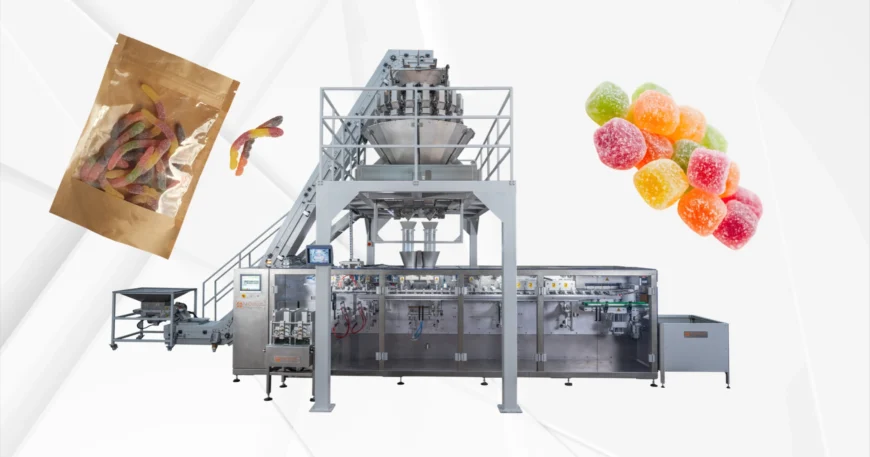
Gummy Candy Packaging Machine
In gummy candy production, selecting the right packaging technology is just as important as maintaining product quality. Sticky surfaces, different product shapes, precise weighing requirements, and high production capacities demand specialized packaging solutions. A Gummy Candy Packaging Machine addresses these challenges by ensuring accurate weighing, hygienic packaging, and efficient preparation of products for distribution and sale.
However, choosing the right packaging machine involves more than simply evaluating its speed. Product characteristics, packaging formats, target weights, and production line conditions must all be considered. Packplus provides automated weighing, filling, and packaging solutions designed for different types of gummy candies, helping manufacturers establish efficient, reliable, and controlled packaging operations.
What Is a Gummy Candy Packaging Machine and How Does It Work?
A Gummy Candy Packaging Machine is an industrial packaging system designed to automatically weigh, fill, and seal gummy candies, soft confectionery, and similar products according to predefined weight requirements. Depending on the physical characteristics of the product, the machine can be configured with different feeding, weighing, and filling technologies.
The automated gummy candy packaging process generally consists of the following stages:
Product Feeding: Gummy candies are transferred to the weighing system using a feeding conveyor or elevator.
Precision Weighing: A multihead weigher determines the optimal product combination to achieve the target weight.
Package Preparation: A premade doypack pouch is opened, or a package is formed from roll film.
Product Filling: The accurately weighed gummy candies are discharged into the prepared package.
Package Sealing: The package is sealed using appropriate temperature and pressure settings.
Discharge and Inspection: Finished packages are transferred via conveyor systems to inspection and secondary packaging operations.
PLC-controlled systems allow operators to manage target weights, filling times, and packaging parameters through a user-friendly interface. This enables more controlled transitions between different products and packaging formats while improving overall production efficiency.
What Are the Most Suitable Packaging Types for Gummy Candy Products?
When selecting gummy candy packaging, manufacturers should consider product shelf life, target consumers, portion sizes, and distribution channels. The right packaging not only protects the product but also improves shelf visibility and the overall consumer experience.
Doypack Packaging (Stand-Up Pouches)
Doypack pouches are widely preferred for gummy candies because of their ability to stand upright on retail shelves. They can be equipped with resealable zippers, transparent windows, and various closure options.
This packaging format is particularly suitable for medium and large portions of gummy candies, offering both convenience and attractive product presentation.
Pillow Bag Packaging
Pillow bags are formed from roll film and provide an economical solution for automated gummy candy packaging.
Their relatively low packaging material costs and potential for high-speed production make them suitable for single-serving products and standard-weight confectionery packages.
Gusseted and Flat-Bottom Pouches
Gusseted and flat-bottom pouches are suitable for products requiring greater filling volume and stable shelf positioning.
Their structure provides improved package stability and convenient handling, making them an attractive option for larger gummy candy portions.
Packplus offers premade pouch filling and vertical packaging solutions that can be configured for different packaging formats based on product characteristics and production requirements.
When selecting a packaging format, manufacturers should also evaluate film structure, sealing requirements, and filling opening dimensions.
What Types of Products Are Compatible with a Gummy Candy Packaging Machine?
Not all gummy candies have the same physical characteristics. Surface coatings, moisture content, product dimensions, and elasticity directly affect how products move through packaging equipment.
With suitable feeding and weighing systems, automated gummy packaging machines can handle various confectionery products.
- Sugar-Coated Gummies: Products with surface coatings that may help reduce certain sticking problems during handling.
- Sour Gummies: Products coated with sugar and acidic ingredients that require careful consideration of residue accumulation on equipment surfaces.
- Oil-Coated Gummies: Confectionery products requiring controlled product flow and easily cleanable contact surfaces.
- Soft and Filled Gummies: Delicate products that benefit from gentle handling systems to minimize crushing and deformation.
- Different Gummy Shapes: Gummy bears, rings, worms, fruit-shaped candies, and other irregular shapes requiring suitable feeding channels and hopper configurations.
For highly sticky products, standard weighing equipment may not deliver the required performance.
Therefore, before selecting a gummy candy packaging machine, conducting filling and weighing trials with actual product samples is essential.
These tests help determine the most suitable equipment configuration, operating parameters, and achievable packaging performance.
How Is Weight Accuracy Achieved in Gummy Candy Packaging?
Weight accuracy is a critical factor in gummy candy packaging operations. It directly affects product costs, packaging consistency, and compliance with declared net weight requirements.
One of the most widely used technologies for this application is the multihead weigher.
Multihead weighing systems evaluate product weights across multiple weighing hoppers and calculate the most suitable combination to achieve the target weight.
For example, when packaging 100 grams of gummy candies, the system can combine portions from several weighing hoppers instead of relying on a single discharge.
This approach helps reduce unnecessary product overfilling while maintaining consistent package weights.
Several factors influence weighing accuracy:
- Individual product weights and dimensional variations
- Consistent product distribution across weighing hoppers
- Vibratory feeder settings and feeding stability
- Product surface stickiness
- Weighing system calibration and environmental vibrations
A properly configured weighing system can minimize product giveaway and deliver more consistent filling results.
However, actual weighing tolerances depend on product characteristics, target weights, and operating speeds. Performance should therefore be verified through product-specific testing.
Gummy Candy Packaging Machine Prices and Return on Investment
Gummy Candy Packaging Machine prices vary depending on the selected machine model, automation level, weighing technology, packaging format, and required production capacity.
For example, a single-lane packaging system and a high-capacity dual-lane solution have different investment requirements.
Additional equipment, including multihead weighers, feeding elevators, discharge conveyors, and inspection systems, can also influence the total project cost.
When evaluating a packaging investment, manufacturers should consider more than the initial purchase price.
The total cost of ownership provides a more accurate understanding of long-term operational expenses and potential savings.
Evaluation Criteria | Impact on Investment |
|---|---|
Packaging Capacity | Number of packages produced per unit of time |
Weighing Accuracy | Product costs associated with overfilling |
Labor Requirements | Operational staffing expenses |
Packaging Material Consumption | Packaging cost per finished package |
Maintenance and Downtime | Production continuity and operational efficiency |
How Is the Return on Investment Calculated?
A simple payback period can be calculated by dividing the total investment cost by the annual net savings generated through automation.
For example, if an automated packaging system requires an investment of 3,000,000 monetary units and generates annual net savings of 1,000,000 units, the simple payback period would be approximately three years.
This is an illustrative calculation. Actual results depend on production volumes, operating expenses, equipment utilization, and achieved efficiency improvements.
Choosing the right gummy candy packaging machine can help manufacturers reduce product giveaway, improve packaging consistency, and optimize long-term production costs.
What Are the Capacity and Speed Performance of a Gummy Candy Packaging Machine?
The production capacity of gummy candy packaging equipment is generally measured in packages per minute (PPM).
However, the maximum mechanical speed of a machine may differ from the sustainable production speed achieved under actual operating conditions.
Several factors influence packaging performance:
- Product stickiness and flow characteristics
- Target package weight
- Packaging dimensions and material properties
- Multihead weighing combinations
- Filling and sealing cycle times
- Product feeding consistency
For example, smaller portions of free-flowing gummy candies may allow higher packaging speeds.
In contrast, larger portions or highly sticky products may require longer filling cycles, potentially reducing overall throughput.
How Is Hourly Packaging Capacity Calculated?
The theoretical hourly production capacity can be calculated using the following formula:
Hourly Theoretical Capacity = Packages per Minute × 60
For example, a machine operating at 50 packages per minute has a theoretical capacity of:
50 × 60 = 3,000 packages per hour
However, actual output may be lower due to machine stoppages, product feeding interruptions, changeovers, and operational efficiency.
With Packplus packaging solutions, the appropriate production capacity is determined by evaluating product samples, target weights, packaging dimensions, and required output rates.
This approach helps manufacturers select equipment that meets their production requirements without unnecessary capacity or investment costs.
How to Prevent Product Sticking During Gummy Candy Packaging
One of the most common technical challenges in gummy candy packaging is product sticking.
Gummy candies may stick to each other or to equipment surfaces, causing accumulation inside weighing hoppers, inconsistent product flow, and reduced packaging speeds.
Several methods can help minimize these problems.
1. Using Suitable Product Contact Surfaces
Appropriate surface coatings, specialized equipment geometries, and food-contact-compatible materials can help gummy candies move more smoothly through the packaging system.
The selection of contact surfaces should be based on the product’s formulation and physical properties.
2. Optimizing Vibratory Feeding Systems
Vibration amplitude and feeding duration should be adjusted according to the characteristics of the gummy candies.
Excessive vibration may cause deformation in delicate products, while insufficient vibration can result in inconsistent feeding.
Proper adjustment helps maintain stable product flow and weighing performance.
3. Controlling Temperature and Humidity
High temperatures and humidity levels can increase surface stickiness in certain gummy candy formulations.
Maintaining suitable environmental conditions in the production area can help reduce sticking problems and improve packaging consistency.
4. Reducing Product Drop Heights
Controlled product transfer and optimized discharge heights can minimize deformation and accumulation, particularly when handling soft or filled gummy candies.
Gentle handling is especially important for products that are sensitive to mechanical impact.
5. Performing Regular Cleaning and Product Testing
Sugar residues and coating materials should not be allowed to accumulate on equipment surfaces.
Regular cleaning helps maintain stable product flow and supports hygienic production conditions.
Additionally, conducting product trials before full-scale production helps determine the most suitable equipment configuration and operating parameters.
Cleaning and Hygiene Standards in Gummy Candy Packaging
Packaging equipment used in gummy candy and confectionery production should be designed to meet applicable food safety requirements.
In particular, surfaces that come into direct contact with products must be easy to clean and designed to minimize residue accumulation.
When selecting a Gummy Candy Packaging Machine, manufacturers should evaluate stainless steel contact surfaces, accessible weighing hoppers, removable product channels, and hygienic equipment design.
Important hygiene practices in gummy candy packaging include:
- Using appropriate food-contact materials for product-contact components
- Establishing cleaning procedures based on product characteristics
- Regularly removing sugar, oil, and coating residues
- Controlling cross-contamination risks during product changeovers
- Properly drying equipment after cleaning
- Documenting maintenance and sanitation procedures
Food safety management practices based on HACCP (Hazard Analysis and Critical Control Points) principles help manufacturers systematically identify and control potential risks throughout the production process.
Hygienic equipment design not only supports product safety but can also reduce cleaning times and improve production continuity.
For manufacturers operating multiple product lines, easy access to contact surfaces and efficient cleaning procedures can provide significant operational advantages.
Find the Right Gummy Candy Packaging Solution with Packplus
A successful gummy candy packaging investment begins with selecting the right weighing technology and packaging system for the product’s physical characteristics.
Packplus provides automated packaging solutions for different production requirements through its premade doypack and vertical packaging machines.
Whether you need accurate weighing, efficient filling, flexible packaging formats, or reliable production performance, selecting the appropriate equipment configuration is essential for long-term operational efficiency.
Share your product specifications, target package weights, packaging dimensions, and required production capacity with Packplus to receive a technical evaluation and a customized packaging machine quotation.
Contact Packplus today and discover the most suitable automated gummy candy packaging solution for your production line.